Cast nylon parts
Cast nylon bushings and plain bearings
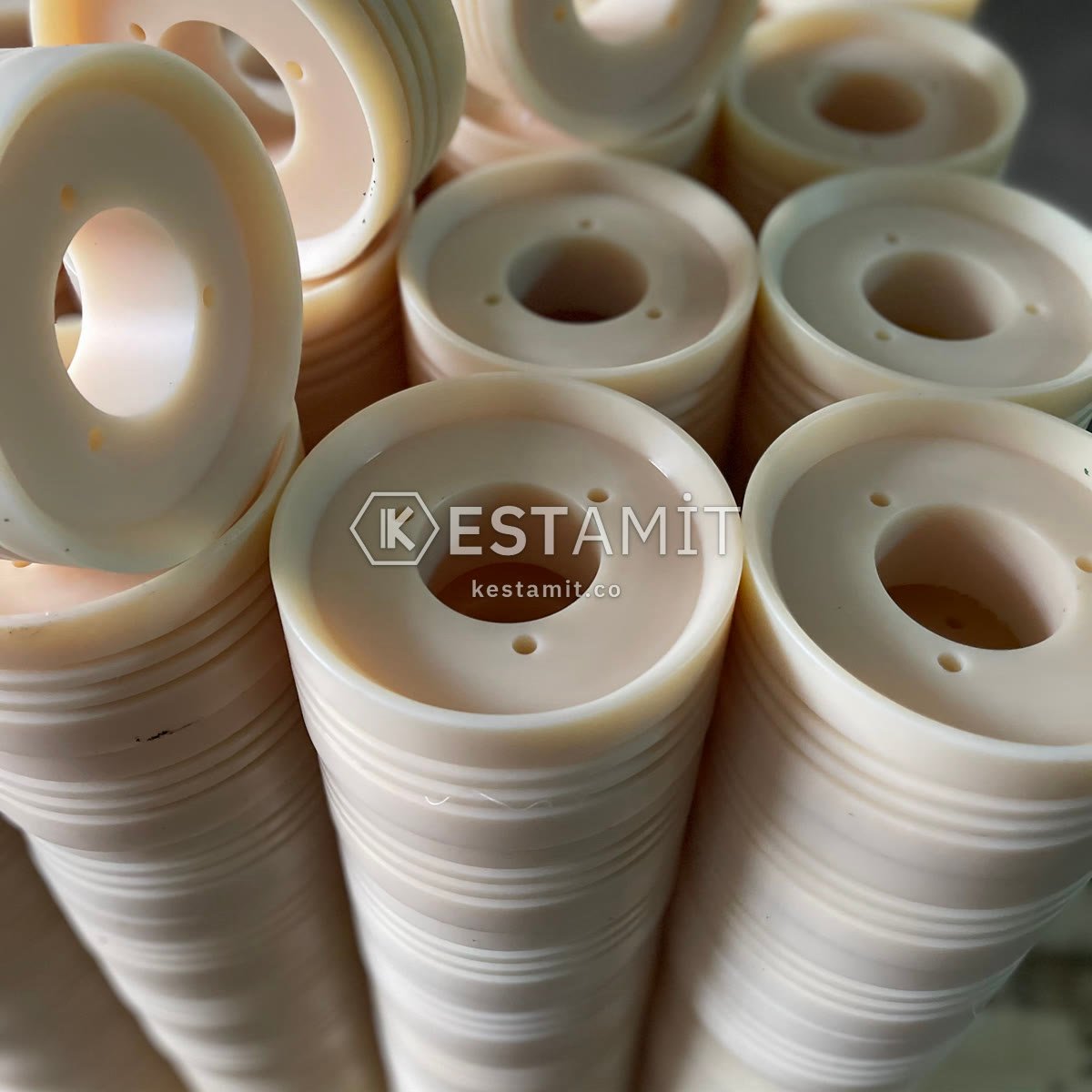
Bushings are one of the most common jobs for cast nylon. They are easy to fit but fail early if a few design rules are ignored.
Why a cast nylon bushing?
- Light: about one seventh of the weight of a bronze bushing.
- Kind to shafts: tends to wear a steel shaft less.
- Little oil: useful where lubrication is hard.
- Easy to machine: custom bushings are made quickly.
Why clearance is critical
Cast nylon grows for two reasons: moisture and heat. Without enough clearance the bushing tightens, heats up and tightens more. This cycle quickly causes damage. So:
- Set the working temperature and humidity at the start.
- Do not use steel clearance values.
- On critical jobs, make a trial bushing and measure it in real conditions.
How to prevent heating
- A thinner wall releases heat better.
- A grease groove reduces friction.
- Oil-filled cast nylon lowers friction where lubrication is hard.
- A hard, smooth shaft reduces wear.
Cast nylon or bronze?
Bronze carries higher loads and temperatures. Cast nylon is light, cheap to start with and runs with little oil. See cast nylon vs bronze.
Fitting the bushing
Press fit
Pressed into a housing, the bushing's bore shrinks. Check the size after fitting.
Holding it
In hot and humid conditions the housing and bushing expand differently. A press fit alone may not be enough. Use a flange, circlip or pin to stop rotation.
Flanged bushing
For axial load a flanged bushing works well. A radius under the flange reduces crack risk.
The shaft matters
- A rough shaft wears the bushing like sandpaper.
- A very polished shaft may not hold an oil film.
- A rusty shaft speeds up wear.
- A hard, smooth steel shaft is a good match.
Lubrication options
| Method | Note |
|---|---|
| None | Possible at low load and speed |
| Initial grease | Reduces wear while running in |
| Regular grease | More effective with a grease groove |
| Oil-filled cast nylon | When external lubrication is hard |
Failure signs and causes
| Sign | Likely cause |
|---|---|
| Bushing seized on shaft | Too little clearance, high moisture or heat |
| Bore grew | Normal wear or a rough shaft |
| Bushing melted or glazed | Too much heat, load and speed too high |
| Bushing turned in housing | Loose fit, no retention |
What to send us
Outer diameter, bore, length, flange size, shaft material, speed, load, temperature and quantity.
Frequently asked questions
Should a cast nylon bushing be lubricated?
It can run dry, but a little lubrication extends life. Even initial greasing can reduce wear clearly.
Why does the bushing seize on the shaft?
Usually the clearance is too small and the bushing has swollen with moisture or heat. Recalculate clearance for the working conditions.
Can a cast nylon bushing run in water?
Yes, but allow for swelling. For permanently wet, tight tolerance work, look at materials that absorb less moisture.
Figures are typical values published by manufacturers and vary with grade and test conditions. Ask us for exact values.