Machining and ordering
CNC machining of cast nylon
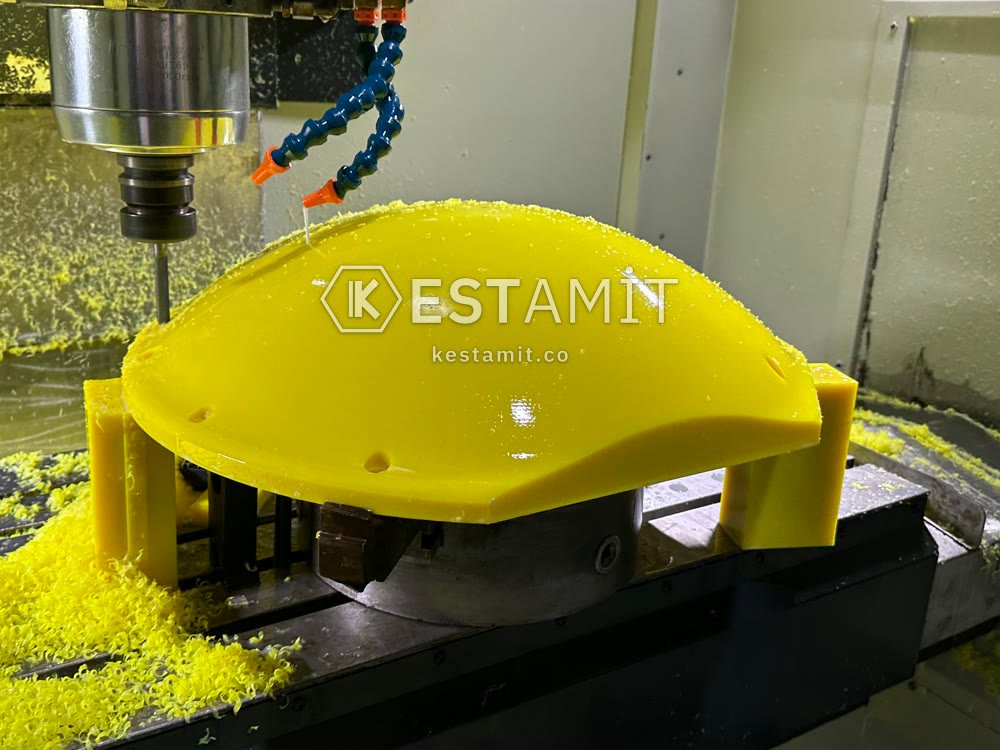
Machinability is one of the main advantages of cast nylon. Machinists used to metal need to change only a few habits.
Points to watch
- Chips: cast nylon tends to form long chips that wrap around the tool. Use chip breakers and clear chips well.
- Clamping: it is softer than metal. Too much pressure crushes thin walls and the size changes on release.
- Heat: it conducts heat poorly. Blunt tools heat the surface and the size drifts. Use sharp tools and, if needed, air or coolant.
- Cold material: cast nylon loses toughness in the cold. Let large stock reach workshop temperature before machining.
- Checking size: measure after the part has cooled.
Preparing a drawing
- Add radii to inside corners.
- Avoid very thin walls without support.
- Use a metal thread insert where screws are removed often.
- Mark only the working surfaces and critical sizes.
| File | Best for |
|---|---|
| STEP | 3D parts, most practical for CNC |
| DXF | Flat plates and hole patterns |
| PDF drawing | Tolerances and notes |
Tolerances
Do not copy steel tolerances directly. Moisture and temperature change the size of cast nylon, so a very tight tolerance may not hold in service.
If we machine it for you
We cast the sheet, then cut and machine it to your drawing. You send the size or drawing, we cut and machine it, then we strap it to a pallet and ship it.
Frequently asked questions
Which tools are used?
Sharp carbide or HSS tools. Sharp tools designed for aluminium usually work well.
Is coolant required?
Not always. Blowing with air is often enough. On heavy cuts, coolant helps control size.
Can you machine 3D surfaces?
Yes. The domed part and mould plate in our photos were machined on CNC. Send us your model.
Figures are typical values published by manufacturers and vary with grade and test conditions. Ask us for exact values.