Sheet, rod and tube
Cast nylon sheet guide
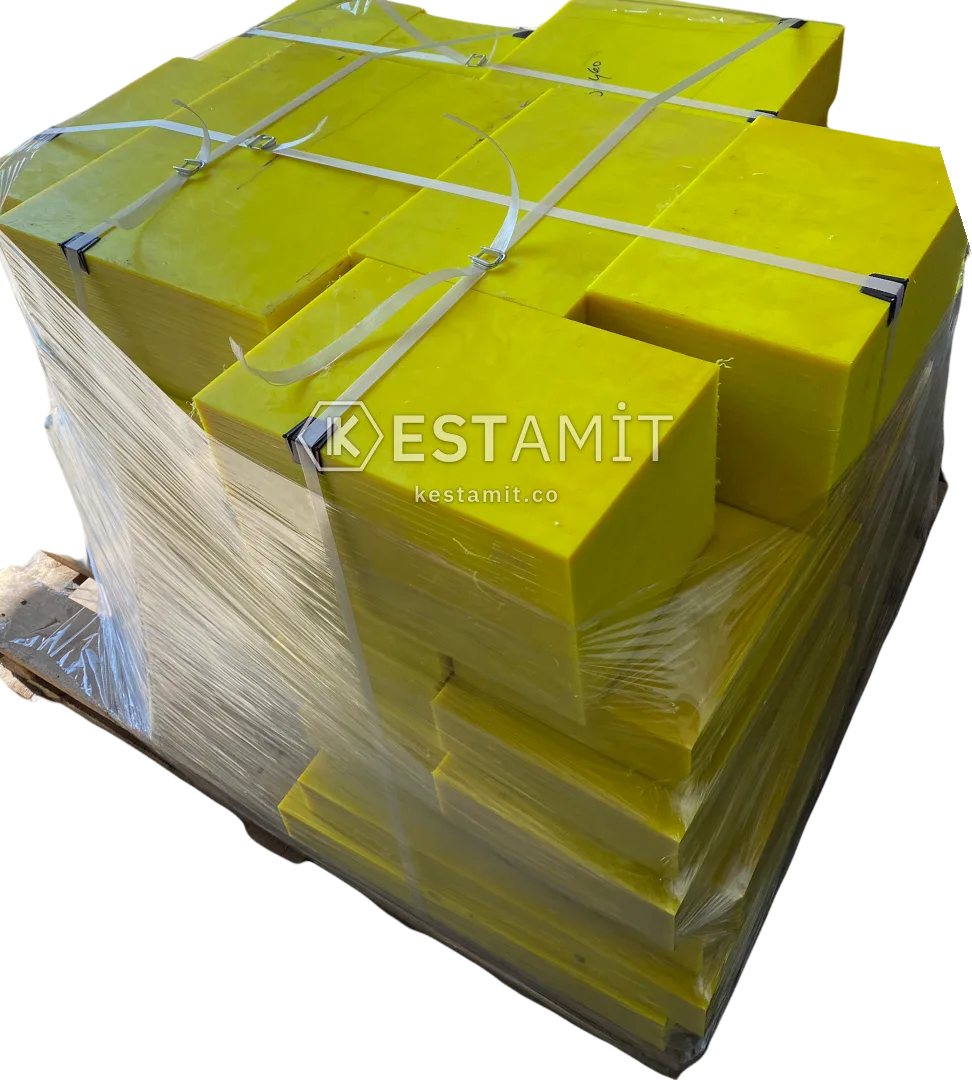
Sheet is the most requested form of cast nylon, because one plate can become flat parts and complex machined parts.
Where is cast nylon sheet used?
- Wear plates and sliding guides
- Conveyor rails and guides
- Mould plates and fixtures
- Drilled connection plates, comb plates, U-cut plates
- Gear and pulley bodies
Five questions for choosing sheet
1. How high is the load?
A wide load area needs a thinner sheet. A point load needs more thickness. Cast nylon is far more flexible than steel, so allow for bending.
2. Is there friction?
Where lubrication is hard, consider oil-filled. In abrasive conditions, look at MoS2.
3. What is the temperature?
The continuous limit is about 100 °C. See temperature limits.
4. Is it wet?
Moisture changes size, and the effect adds up on long plates. See moisture.
5. Which size is most efficient?
Think about how your parts nest on the sheet. The right size reduces waste.
Size and weight
A 1000 × 2000 mm sheet at 20 mm weighs about 46 kg. See the weight guide. Standard sizes vary by maker. Tell us your need and we will confirm what we can supply.
Full sheet, cut to size or finished part?
- Full sheet: for those who cut and machine in their own shop.
- Cut to size: a ready start with little waste.
- Finished part: we machine holes, grooves and curves. See CNC machining.
Cutting and fixing
Cutting
Band saws and CNC cut it cleanly. On thick sheet chips can wrap around the blade, so tooth pitch and chip removal matter. We cut the thick block in our photos this way.
Holes
Holes are drilled or machined on CNC. If the material heats while drilling, the hole can end up a little small. Check critical holes after cooling.
Threads
Threads can be cut in cast nylon, but a metal thread insert lasts longer where screws are removed often.
Standard and tolerances
Makers of cast polyamide semi-finished products often refer to DIN EN 15860. It gives a frame for size tolerances, but ask about thickness tolerance before ordering. Cast sheet is not as tight as a machined part. If you need precise thickness, the sheet must be machined.
Storage
- Stack flat and supported.
- Avoid pressure on the edges.
- Keep out of direct sun and wet areas.
- Let sheet from a cold store reach workshop temperature before machining.
Nesting for efficiency
When cutting many parts, the layout matters. Fitting small parts between large ones reduces waste. Share your full parts list rather than one part at a time.
Frequently asked questions
Can cast nylon sheet be cut?
Yes, with band saws, circular saws and CNC. On thick sheet, blade choice and chip removal matter.
Can cast nylon sheet be bent?
It is not suited to cold bending. Curved parts are usually machined on CNC.
Can the sheet be glued?
Polyamide surfaces are hard to bond. For high loads, mechanical fixing with bolts and countersinks is safer.
Figures are typical values published by manufacturers and vary with grade and test conditions. Ask us for exact values.