Temperature and resistance
Is cast nylon heat resistant?
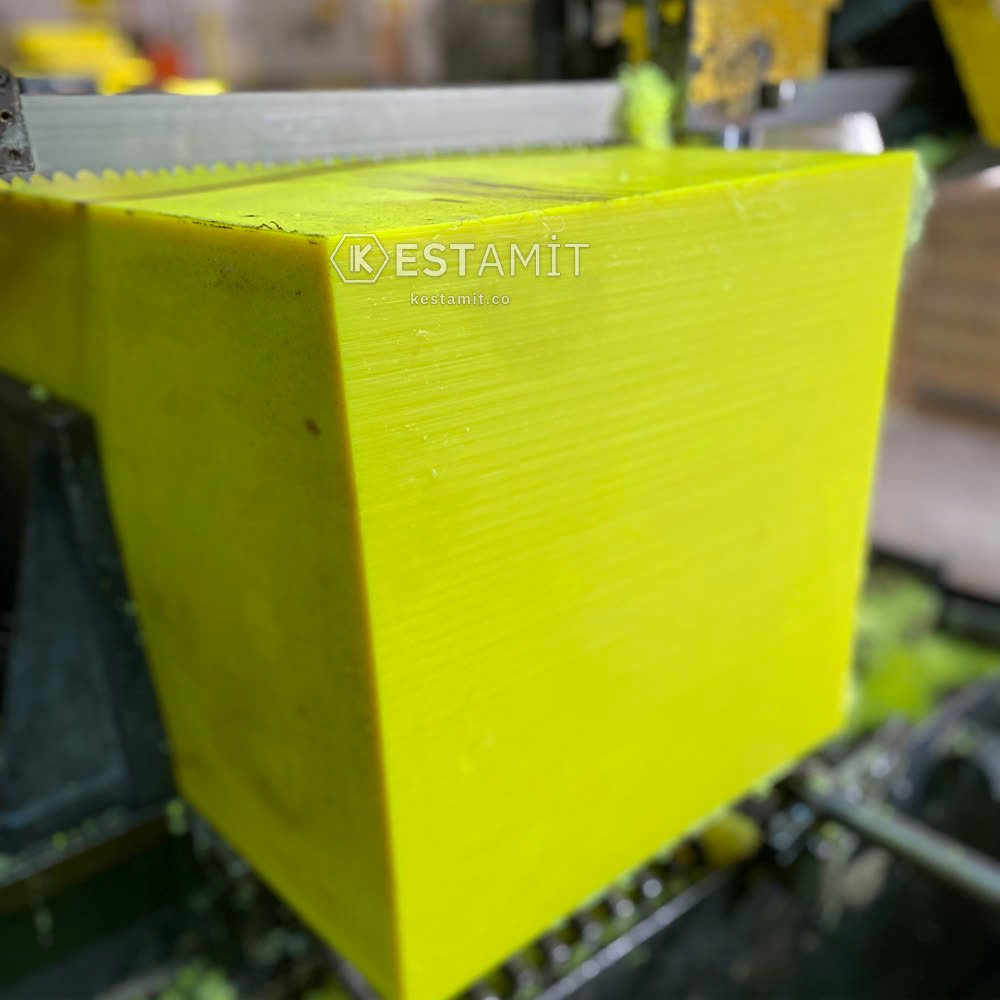
"Heat resistant" is vague. The real question is: at what temperature, under what load and for how long?
What happens as it heats up?
It softens
Cast nylon loses hardness and stiffness as temperature rises. Under load, permanent deformation starts.
It expands
Plastics expand far more than metal. A typical value for cast nylon is about 8.5 × 10⁻⁵ / °C. For steel it is about 1.2 × 10⁻⁵ / °C.
| Example | Temperature rise | Growth |
|---|---|---|
| 1000 mm cast nylon plate | 20 °C | About 1.7 mm |
| 1000 mm steel plate | 20 °C | About 0.24 mm |
On long wear plates, give holes and gaps room for expansion.
It holds heat
Cast nylon does not conduct heat like metal. Friction heat stays in the part. When sliding speed and load rise together, the part runs much hotter than its surroundings.
How to prevent heat problems
- Measure the working temperature, not just the room temperature.
- Leave expansion room on long parts.
- Use lubrication or oil-filled cast nylon in bearings and bushings.
- Avoid direct contact with heat sources.
When do you need another material?
- Continuous work above 100 °C
- Direct contact with a heat source
- High load at high temperature
Here heat stabilised grades, other engineering plastics or metal come into play. See temperature limits.
Checklist for hot environments
- What is the highest working temperature?
- Is it continuous or brief?
- Does the part carry load when hot?
- Does heat come directly or from the surroundings?
- Does the part go through heating and cooling cycles?
- What happens if the size drifts?
The answers often decide the material on their own.
Why thermal cycles matter
A part that heats and cools expands and shrinks every cycle. On a long plate fixed with rigid bolts this creates stress, and cracks can start around holes. Use slotted holes and room to move. See the wear plate guide.
Consider moisture in hot weather
Hot and humid air can speed up moisture uptake. Hot and dry air can dry the part and make it shrink a little. You may measure different sizes in summer and winter. This is normal, but allow for it in parts with critical clearance such as bushings.
Fire safety
Cast nylon is not flame retardant. Its typical rating is UL94 HB. If fire rules apply, share the specification at the start. Protect cast nylon parts from sparks in welding or grinding areas.
Other ways to handle heat
Before changing material, see if the temperature can come down. A heat shield, more distance from the source, a metal interface or better lubrication is often enough. This keeps the lightness and quiet running of cast nylon.
Frequently asked questions
Does cast nylon burn?
Yes, it is a plastic and burns at high enough heat. Its typical rating is UL94 HB, it is not flame retardant.
Can cast nylon be used in hot water?
It can, but hot water speeds up moisture uptake and size change. Choose carefully for hot and always wet conditions.
Is there heat stabilised cast nylon?
Heat stabilised PA6G grades exist. Write your need in the request and we will confirm whether one suits.
Figures are typical values published by manufacturers and vary with grade and test conditions. Ask us for exact values.