Sheet, rod and tube
Cast nylon tube and hollow parts
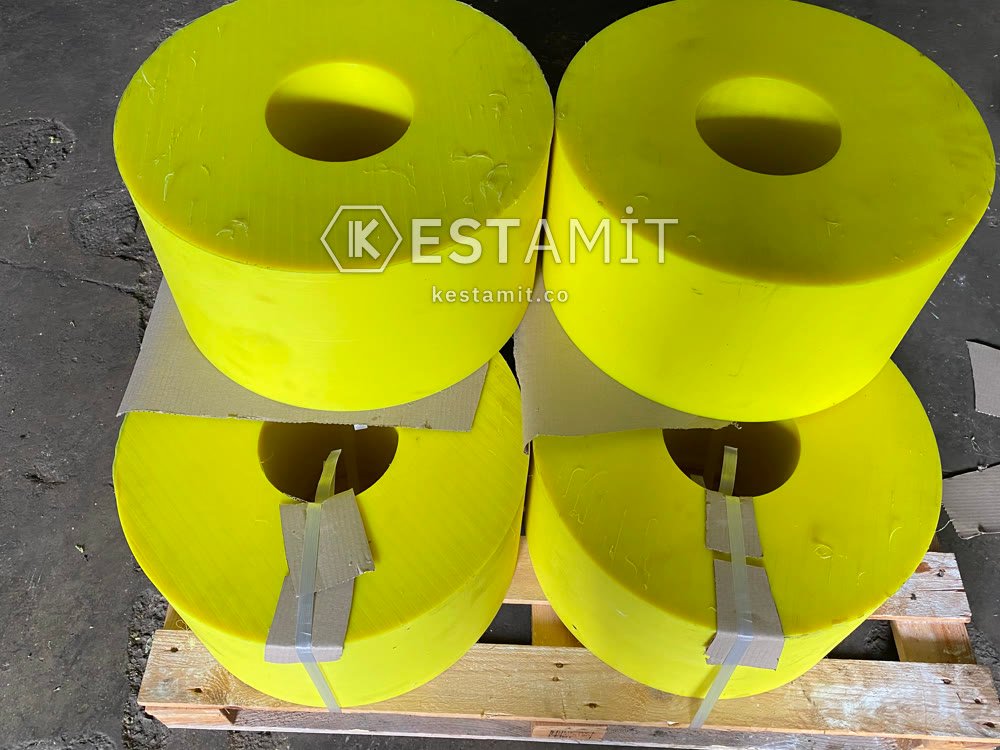
Boring a large hole in solid rod turns much of what you bought into chips. A tube or hollow start reduces that.
Solid rod vs tube
Density 1.15 g/cm³, length 1000 mm.
| Outer | Inner | Tube weight | Solid rod | Difference |
|---|---|---|---|---|
| 100 mm | 50 mm | 6.8 kg | 9.0 kg | 2.2 kg |
| 200 mm | 100 mm | 27.1 kg | 36.1 kg | 9.0 kg |
| 300 mm | 200 mm | 45.2 kg | 81.3 kg | 36.1 kg |
The difference grows fast with the bore. See the weight guide.
When does tube make sense?
- Bushings with large bores
- Rings and flanges
- Large roller and sheave bodies
- Rotating parts that must be light
When is solid rod better?
- When the bore is small
- When the part has a varying profile or blind holes
- When testing a single part
Do not forget allowance
A tube needs allowance on both outer and inner diameter. Give us the finished size and we will set the start size.
Wall thickness
Thin walls are lighter and release heat better but flex under load. Thick walls are stiffer but hold heat. In plain bearings a very thick wall is not always better.
Clamping
A tube can be crushed in the chuck. To reduce this:
- Use wide or soft jaws.
- Put a support plug inside.
- Lower clamping pressure on the final pass.
- Support at two points where possible.
A crushed part springs back on release and the size is lost.
Cast near-shape starts
Casting suits near-shape starts. For large parts, a hollow or specially shaped casting can cut chips a lot. The large drilled cylinders in our photos are an example.
Example
A ring with 300 mm outer, 200 mm inner, 200 mm long:
| Start | Weight |
|---|---|
| Solid rod | About 16.3 kg |
| Hollow start | About 9.0 kg |
About 7 kg of material does not become chips, and machining time drops too.
Frequently asked questions
Is cast nylon tube available in every size?
It depends on the maker and the casting mould. Tell us the outer and inner diameter you need.
Tube or machined ring?
With a workshop, tube makes sense. Without one, ordering the finished ring is simpler.
Is tube weaker than solid rod?
Its section is smaller, but in bushings and rings the load sits at the wall, so the right wall thickness is enough.
Figures are typical values published by manufacturers and vary with grade and test conditions. Ask us for exact values.