Sheet, rod and tube
Cast nylon rod guide
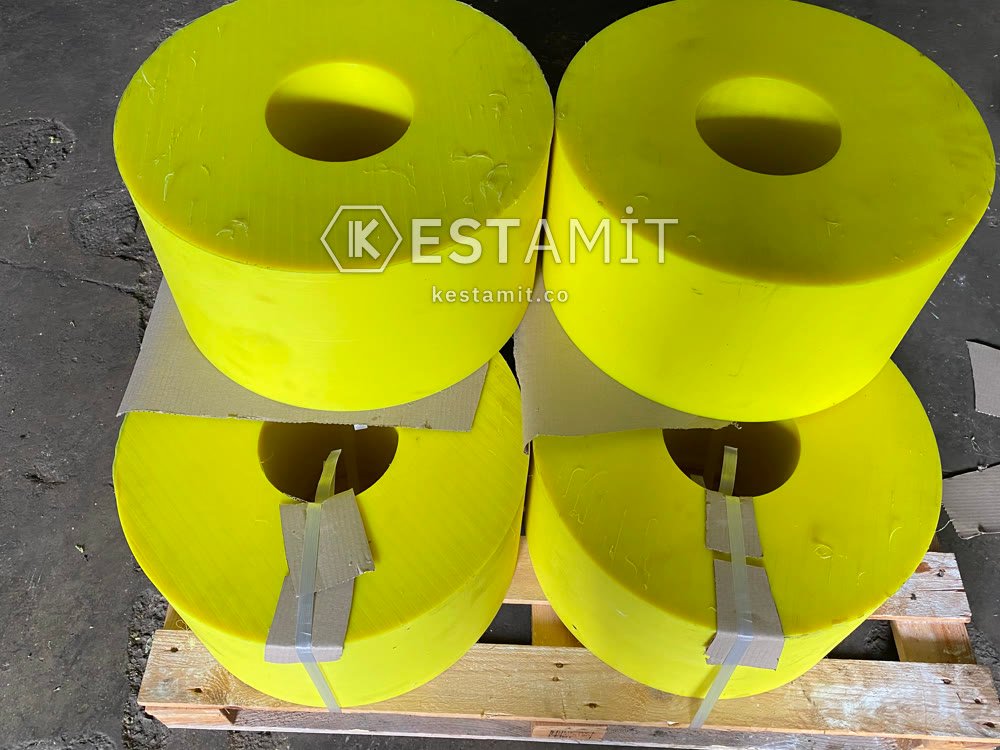
For round parts the starting material is usually rod. The right diameter decides both chips and cost.
What is made from cast nylon rod?
- Bushings and plain bearings
- Pulleys and sheaves
- Gears and sprockets
- Wheels and rollers
- Connection and guide parts
Choosing the diameter
Add enough to the finished size for a clean surface. Too little leaves a raw surface. Too much adds chips and cost.
| Finished part | How to think about allowance |
|---|---|
| Short, small diameter | A small allowance is enough |
| Long part | More allowance for runout |
| Large diameter | Allow for material tolerance too |
We set the exact allowance together for each part.
Rod weight
A 100 mm rod weighs about 9 kg per metre, a 200 mm rod about 36 kg. See the rod price guide for the table.
Machining notes
- Cast nylon tends to form long chips. Plan chip removal.
- Do not machine cold stock. Toughness drops in the cold and large diameters risk cracking.
- Clamp carefully. It is softer than metal and thin walls can be crushed.
See CNC machining.
Example: choosing rod for a bushing
Twenty bushings, finished outer 80 mm, inner 50 mm, length 60 mm:
- Add surface allowance to the outer diameter. 85 to 90 mm is a sensible start.
- Add cutting and facing allowance per part. 65 to 70 mm per part is a good start.
- Calculate total length for 20 parts. About 1400 mm, plus chucking length.
- Find the weight. 90 mm diameter, 1.4 m long is about 10.2 kg.
Runout on long parts
Long rods can vibrate or run out on the lathe. Cast nylon is more flexible than steel, so this shows sooner. Use tailstock and steady support and set cut depth to suit.
Storage
Store long rods horizontally and supported. Holding them only at the ends can bend them over time, especially when warm. A small bend is usually removed by the machining allowance.
Rod or machined part?
| Situation | Suggestion |
|---|---|
| You have a lathe and machine few parts | Rod |
| You have no machine | Machined part |
| Complex profile and grooves | Machined part |
| You make spare parts regularly | Stocking rod can make sense |
For bushings see oil-filled. For abrasive conditions see MoS2. The standard grade is a balanced start for general work.
Solid or hollow?
A part with a large bore wastes a lot of solid rod. A tube or hollow start makes more sense.
Frequently asked questions
What diameters are available?
The range varies by maker. Casting allows large diameters. Tell us the diameter you need.
Rod or sheet?
Rod usually wastes less for round parts, sheet for flat or square ones.
Is rod hard to turn?
No, cast nylon turns easily. Manage long chips and use sharp tools.
Figures are typical values published by manufacturers and vary with grade and test conditions. Ask us for exact values.